Sunday, April 23, 2017

The Real Reasons Why Marriages Fail — And How To Not Let Yours Suffer The Same Fate

The best way to make sure your marriage is a success story is to know the key things that can cause a marriage to fail, then put in the time and effort to make sure it doesn’t happen to you.


For BRIDES, by Jaimie Mackey.--From Huffington Post

You’re going into your marriage with your heart in the right place — because you’re in love and want to spend your lives together! — but even as the divorce rate drops, not every marriage is destined for success. However, yours doesn’t have to be one of the ones that fail! Our experts are here to break down four reasons marriages might not succeed and share some tips to keep yours strong. The best way to make sure your marriage is a success story is to know the key things that can cause a marriage to fail, then put in the time and effort to make sure it doesn’t happen to you. Dating strategist Jasmine Diaz shares four essential parts of any relationship that can lead to divorce if not addressed. 

 Lack of Communication 

 “Many couples either don’t know how to communicate their feelings effectively enough for their partner to understand and receive what they’re saying or simply don’t communicate at all,” says Diaz. “It may sound clichéd, but communication is the foundation of every relationship. How can you expect your partner to make positive changes for the betterment of your relationship if he or she doesn’t know changes are needed?” Remember, your husband or wife is not a mind reader! If communication is not your specialty, set aside a time once a week for a real catch-up session. “Spend this time talking about your week and any issues you might be having. Instead of making it awkward or confrontational, order a pizza and turn it into a lighthearted discussion,” Diaz suggests. By talking regularly, you’ll avoid getting to the point where the wheels are falling off and it’s too late for candid conversations to help. “It’s better to schedule regular check-ups to ward off more serious issues. Why wait until you’re in critical condition?” asks Diaz.

 Lack of Care 

 Every relationship reaches a point when the white gloves come off and the comfort sets in. Comfort has its upsides, but the problems arise when that comfort turns into consideration going out the window. “Being considerate means caring for your partner’s feelings, showing your partner that you love and value them, and being their champion,” says Diaz. “Marriages tend to fail when one partner (or both) stops caring for the other, when the friendship you once had is replaced with anger and resentment. This causes you to stop seeing the things you love about your partner, replacing them with the things you hate.” Avoid this lack of consideration and care by pouring healthy energy into your relationship. “Don’t go weeks or months without a date night,” Diaz advises. “Schedule a few dates per month to keep your feelings fresh. Tend to your relationship with a healthy dose of love and attention.”

 Lack of Commitment 

 “They say that anything worthwhile takes hard work, and the same is true for marriage,” says Diaz. “But if you’re the type of person who doesn’t like confrontation or gives up easily, you may find yourself divorced more quickly than you realize.” She emphasizes recognizing if you’re not ready to talk about a problem yet — but never acting as though the problem doesn’t exist. “Being in a healthy relationship takes a certain level of availability, and you have to be willing to stick it out when the going gets rough, because it will. Be physically, mentally, emotionally, and spiritually present in your relationship and for your partner. Listen even when you don’t agree, and make a conscious decision to put in the work.” If you make divorce an option for dealing with tough situations, it will become a default opt-out. “Instead, say to your partner, ‘I want to fix this.’ You’ll be surprised by the solutions that will come out of it!”

 Lack of Intimacy 

 Intimacy, by definition, is about closeness and togetherness. But for some couples, relationship problems can become a barrier to entry. “The closeness you felt in the early stages of your relationship can be replaced with different emotions, and that once-free-flowing sex life can be diminished from once a day to once a month to never,” says Diaz. “It’s easy to look at sex and try to find a simple solution — for some this means more sex — but that treats the symptoms and may not treat the actual problem if there’s a breakdown of intimacy,” Diaz explains. “Combat it by creating more opportunities for intimate moments. Light candles and play romantic music while you’re cooking at home. Enhance the things you already do together, and dedicate yourself to being present. Forget technology and consider only your partner, giving yourselves the opportunity to create intimacy.”

Thursday, April 13, 2017

8 Happily Married Women Share The Secrets They Keep From Their Husbands

For BRIDES, by Sherry Amatenstein, LCSW.

“He’s a really good lover but terribly insecure so I don’t tell him when I don’t have an orgasm.”—Linette

 “My mother always told me to have access to my own money so though Jim and I have a joint account I have a ‘secret’ stash as well that I’ve never mentioned.”—Jill

 “When we first got married he bragged that he was a great cook. Then he actually made me what he thought was a gourmet meal. I didn’t want to hurt his feelings so I said it was fabulous but I wound up going to the bathroom to throw up! Thankfully he doesn’t cook often — I’ve said it’s something I love to do, mainly to keep him out of the kitchen, except on cleanup. However on the rare occasions he does more than scramble an egg or brew coffee I still pretend he’s Bobby Flay… Ugh.”—Emily

 “It’s ridiculous but I’d have to be tortured before I admit to him that I get my lip waxed on a regular basis!”—Sandy

 “I trust him but I still hack into his emails every few weeks—yes, I know his password.”—Pamela

 “I start dreading visits to his mother weeks in advance. Ed turns into such a mama’s boy in her presence I find it nauseating. She’s also jealous of me—and makes mean, annoying comments like ‘Of course Ed doesn’t like beets. How don’t you know that?’ — to prove she will always know him better. I don’t say anything to Ed about my true feelings because he’s a great husband and I don’t want him to feel caught in the middle.”—Beth

 “My college sweetheart came to town and I met him for brunch. It was the first time we’d seen each other in 10 years. My husband, Bill, had absolutely nothing to worry about—I loved and love him madly — and yet I withheld that I got together with Greg. Why? I’d made a stink when Bill asked if it was okay to see his ex-girlfriend so he didn’t meet her. When the same opportunity came up for me and I knew it would be innocent and how wrong I’d been to deny Bill the same option, I just couldn’t bring myself to eat crow. I don’t feel guilty for spending an hour with my ex — it was fun but meaningless, as I knew it would be. But I have sporadic guilt for going behind Bill’s back. Still, it is a secret I will take to the grave!”—Becky

 “I’ve been married nine months and I still haven’t brought myself to tell my husband that I can ‘t go to the bathroom until he leaves the house to go to work or the gym.”—Ann


Thursday, March 23, 2017

5 Things No One Ever Told Me Would Destroy My Marriage

By Louise Armstrong

 As a young bride at 23 years of age, I had no idea what lay ahead, what marriage was really about or what to expect. I was young, innocent, and actually quite clueless so I wanted to share with you a few things that I would have done differently. It might just change how you see your relationship. No one ever mentioned any of these things. What if they had? Perhaps I would have saved myself a lot of heartache. Now, 27 years and 3 children later, I can honestly say that I’m the happiest I’ve ever been. Long-term relationships are worth the effort and the heartache. We all have problems. That’s life. It’s how we deal with them that counts and understanding WHY they happen in the first place is the key. Here are 5 marriage mistakes I wish people had told me:

  1. Judgment

When we continually judge someone, what we’re really saying is their personality is the problem. We see flaws in them as people as opposed to what they are doing. I did this for years, causing argument after argument but if I had looked at myself first and found out how my husband Ian felt and what he needed, the whole situation would have been diffused. Get to know your partner inside out and you’ll stop the judgment. Spend TIME with your partner; the better you get to know him, the deeper your relationship. It’s rare to be like this, I know, but it works.

  2. Being defensive

Are you always on the defensive, always on the attack if you are criticized? Do you continually moan and whine? Do you just refuse to listen? This is one of the biggest disasters for any relationship and I did it for years. I took every comment personally when in reality, it had nothing to do with ME as a person; it was about my behavior, which I could have learned from. Even if your partner continually criticizes you, you can learn to accept the criticism, take responsibility for it, and even ask them to talk to you about it. This diffuses the whole situation and you can learn from it. Perhaps there are changes you could make in your life. Try being positive to your partner in even the smallest of situations and the criticism won’t seem as bad, this really helps to build a relationship. Engage in conversation and notice the humor in situations.This is very powerful in relationship building.

  3. Being condescending 

 This is the biggest issue of all. This is when you try to one up your partner, always putting them down, and making yourself look better. The real reason as to why you do this is because of your insecurities and not his. Take a step back and start looking at yourself. Build your own self-esteem up and boost your self-worth. You’ll stop feeling inferior and putting him down. Start acting like your partner is a hero. Start admiring him and start looking at his great qualities. You’ll be the winner here as this is key in any healthy long-term relationship.

4. Rebuffing your partner 

 You block him out, don’t speak to him, sulk, and shut him out of your life. This tells him is that you don’t care about him, and that’s not really what you mean. Learn to talk to him and ask questions. Putting up blocks and expecting him to guess causes a larger divide between you. Write it down if it’s not clear but stop stonewalling him.

5. Focusing on the negative 


Are you continually looking for the negative in your relationship, focusing on everything that’s going wrong, that you don’t like, that could be better, what others have and you don’t? This leads to real resentment. Instead, learn about gratitude. Focus on the positive in your relationship and build on what you have. The negatives will start to seem insignificant. Talk about your future in a positive way, what your dreams are, and what you would like to achieve together, not what you can’t have or can’t do.


 I hope some of these help you, as they have been an incredible part of my life and the relationship I enjoy with Ian. Communication and having conversations are the key part in healthy relationship — focusing on how you start these conversations can change the whole relationship energy. Relationships are a rollercoaster ride. They are all unique with their own formulas. Louise Armstrong would love to hear what makes your tick. Join her fabulous Facebook group for women: Let’s Talk Relationships & Life. They’d love you to join them. Take the Relationship Quiz right here.

Saturday, January 14, 2017

9 Things Marriage Therapists Know Almost Instantly About A Couple A marriage therapist


 ― even one who’s worked in the field for years ― can’t know a couple’s full story by the first therapy session. They can tell quite a bit, though. (A spouse’s tendency to avoid eye contact, for instance, reveals more than words could ever say.) Below, marriage therapists who have been working with couples for years share nine things they can glean about a couple after the first therapy session.

 1. They know when you’re lying. “What people report in a therapy session has to make sense. If it doesn’t, I know one or both are leaving out important information. Part of the challenge is some people cover things up, some are worried about what I’ll think of them and others lie or have a distorted sense of reality.” ― Becky Whetstone, a marriage family therapist in Little Rock, Arkansas 

2. They can tell when third parties are more than “just friends.” “We can tell when spouses are already in love with other people. The tell-tale sign? When they adamantly defend ‘friendships’ that their partners say have been intrusive and or harmful to their relationships. When you love your spouse and want to keep your relationship from splintering, you acknowledge their desperate requests over the other person.” ― Laurel Steinberg, a New York-based sexologist and adjunct professor of psychology at Columbia University

 3. They read your body language and recognize if it’s telling an entirely different story. “Experienced marriage therapists can read code. That means we can look beyond what is being said and learn about the underlying issues by observing the body language of the couple sitting in front of us. When I notice one partner leaning in, reaching across to touch the other, nodding and gesturing in the direction of the other and the other partner leaning away and avoiding eye contact and physical touch, I know we’ve got a problem. No matter what is being said verbally, the body language is speaking volumes and it’s important for me to listen.” ― Vikki Stark, a psychotherapist and the director of the Sedona Counselling Center of Montreal

 4. They recognize when someone in the relationship is a bully. “This one is pretty easy because usually the partner tries to bully me. The difference is, I haven’t lived with the client for years and had my self-esteem torn to shreds so the bully doesn’t scare me. The thing about bullies is that they really will back down if you call their bluff and let them know where the door to the office is if they don’t really want to get help.” ― Stephanie Buehler, a Southern California-based psychologist

 5. They can sense if you’re willing to own up to your mistakes. “Right off the bat, I ask each half of the couple to describe for me and for each other why they reached out and how I can be helpful. The answer often involves excellent insights about what they wish their partner could do differently. Then I ask each person if they can describe what they are contributing to the problem. If both people can provide even a modest answer to this question, the couple is well positioned to develop a more fulfilling relationship. I want to see a spark of ownership and awareness. The moment one spouse begins describing their contribution to the problem, a look of warmth and relief often spreads over the other partner’s face that transforms the energy in the room.” ― Elisabeth J. LaMotte, a psychotherapist and founder of the DC Counseling and Psychotherapy Center

 6. They can tell if one spouse is an enabler. “You know one partner is an enabler because that person answers questions for the other and defends behavior. When I ask something like, ‘Do you drink every night?’ and a partner rushes to answer, ‘She drinks as much as anyone else,’ then it makes me feel that maybe this person makes excuses for their spouse’s behavior in other realms as well. This often gives rise to a parent-child dynamic where one partner acts in a caretaker role for the other, to a less than functional degree.” ― Samantha Rodman, a psychologist in Takoma Park, Maryland

 7. They know that you should have pursued therapy a lot sooner. “Research suggests that most couples wait six years after trouble emerges before they ask for help. We also know that most couples who divorce do so within the first seven years. So therapists know when you’re coming in later than you should have. The average couple lives with unhappiness for far too long.” ― Zach Brittle, a therapist and founder of the online couples therapy series forBetter

 8. They can tell if the couple had a solid foundation to begin with. “As a marriage therapist I reach to see if there was a time in the relationship when the two people were truly connected and had an intimate bond that we can hopefully restore. Usually, the tension softens as couples tell me about their courtship and the qualities that drew them to each other. When a couple is so entrenched in a negative space that they have difficulty recalling a special time in their relationship, resolution is less likely.” ― Linda Lipshutz, a marriage and family therapist in Palm Beach Gardens, Florida

 9. They know if one partner is already out the door. “Any indication of leaving the marriage can be significant and a difficult hurdle in therapy. Sometimes the couple has consulted a divorce attorney or one partner simply made a statement about moving on with their lives. It’s not so much that they’ve considered the legal process of dissolving a marriage ― it’s that they’ve envisioned a future without their partner. It’s the mindset. Instead of focusing on protecting and saving their marriage, a spouse begins to focus on protecting themselves and their language starts to become more individually oriented. Couples therapy can’t be successful without both partners buying into the relationship for at least for the foreseeable future.” ― Alicia H. Clark, a psychologist based in Washington, D.C.

Friday, November 18, 2016

The Kind of Gift that Money Can't Buy

Often in my near thirty years of practice people who hear that I specialize in family law, ask me "isn't that depressing.?" It is challenging at times, dealing with people who are angry, hurt, and scared is never easy.
Sometimes I do get weary, but I do find deep satisfaction in the fact that most of the time the clients who comes to me in a difficult and often impossible situation, come out the other side in a better place.
Today, when I got back to the office a woman and her husband were waiting for me, they had these beautiful flowers. I had a vague recollection of them. I had represented her in an acrimonious divorce nearly twelve years ago. At the time she had a son who was eight years old. She and her second husband had recently celebrated their 10th anniversary, and they wanted to express their gratitude to me for helping them move on to a happy loving marriage. Her son is a junior in college and they live nearby my office.
These moments mean more to me than awards, money or other accolades ever could. I still use a blanket that was crocheted by an elderly bankruptcy client that her granddaughter brought to me 25 years ago (she was housebound).
I have been blessed to have a passion for my work, I'm not the wealthiest attorney, or famous, but the gifts I have received throughout my career are the kind that come from the heart.


Tuesday, August 2, 2016

I Went Through My Daughter’s Phone, And It May Have Saved Her Life

Is it okay for parents to look through their child’s phone? originally appeared on Quora - the knowledge sharing network where compelling questions are answered by people with unique insights. 

 Answer by Lara Estep, clinical pharmacist and mother, on Quora:

 My youngest children are now in their last years of high school and I would never look through their phones at this point, but when they were younger I always reserved the right to go through phones and Facebook accounts if I suspected they were in an unsafe situation. I only exercised this right once, and I can truly say that I will always be grateful that I did. I am certain that what I found on my daughter’s Facebook messenger and phone that day several years ago saved her from harm. We were relatively new in the neighborhood so I wasn’t familiar with the neighborhood children or their families. I was still figuring out who her friends were.

 After a few months, something just didn’t feel right with my daughter and her friends. But I couldn’t quite put my finger on it. I talked to my ex about it and told him I was thinking of going through her phone and Facebook account (when they were younger I made them give me their passwords to all accounts just in case. I only used them this one time). He was adamantly opposed to my plan. He talked about her privacy and her rights and all of the standard moral and ethical considerations. I agreed with everything he said, but still, something just didn’t feel right.

 Finally, one day I decided that I would rather have my daughter hate me for the rest of her long life than spare myself her anger and possibly allow her to go down a dangerous path and end up harmed or even dead. I think she was thirteen. She had fallen asleep one Saturday afternoon with her phone tucked in her arms. I managed to get the phone and what I found sent chills through my body. I will shorten this and tell you what I found: a chain of Facebook messages and texts from the father of one of her school friends. The friend was a boy. The messages told her how her mother was too strict. That she should go spend the night at his house and he would lie for her. He told her he would bring her cookies, McDonald’s, or whatever she wanted but she would need to sneak out of the house and meet him at the end of the street at night or during lunchtime at school.

The messages came at all hours of the day and night. Sometimes early in the morning to wish her a good day at school. This was a forty-something year old man who I had never met! Texting my daughter! He was clearly grooming her for some bigger plan. It was all I could do not to drive straight to his house and do to him whatever an enraged mama bear does to anyone who threatens her children’s safety. It took a lot of convincing to keep her dad from doing something stupid as well.

 In the end, I scheduled a meeting with the principal of her school the following Monday. After showing him what I had found he had no words. He said in all of his years he had never seen anything like it. I called the police and made a report, but they couldn’t do anything because he hadn’t yet harmed her. I alerted all of the other parents (most of whom didn’t seem to care much, sadly). The hardest part of all was telling her she was no longer allowed to see any of those friends. She hated me for a few months. She told me I ruined her life and would barely speak to me. But I knew in my heart what she couldn’t know. I knew I had saved her from a predator. She soon made new friends and I wasted no time in learning about their families.

She is a happy, well-adjusted, intelligent, ambitious, charming, carefree young lady, unscathed by the intentions of a predator, all because I did the unthinkable, I tossed aside her right to privacy and looked through her phone. I will never regret doing it. And I don’t suggest doing it on a whim. As I stated previously, I had always had their passwords to any account but had never used them. It was my safety net for the “just in case” situation.

 My point is that sometimes we, as parents, need to trust our instincts and do what is best for our children despite what anyone might say. I shudder to think where she would be today if I had listened to her well-intentioned father and not invaded her privacy. Best case scenario we would be in counseling for sexually abused children. Worst case, she would be dead. I expect some judgement, but guess what? I am perfectly fine with that! My daughter still doesn’t understand what happened, and for that good fortune I will trade any judgement that comes my way.

Thursday, July 14, 2016

9 Things Men Hate Hearing From Their Wives

Brittany WongDivorce Editor, The Huffington Post

You’re bound to say some tone-deaf things to your spouse every so often ― but there are some phrases you should absolutely never say. We asked couple therapists to share the most annoying things men report hearing from their spouses. (Of course, it goes both ways ― click here for the annoying things husbands say to their wives.)

 1. “Nevermind, I’ll just do it myself.”

 Marriage pro tip: When you ask your spouse to call the plumber to fix the sink, give him a chance to do it. Rolling your eyes and saying, “nevermind, I’ll do it myself” may result in you getting your sink fixed sooner, but it’s also likely to rub your spouse the wrong way. “Chances are, he wants to help you and make you happy,” said Anne Crowley, an Austin, Texas-based psychologist. “It’s a frustrating phrase for a husband to hear because it suggests you don’t think he’s capable of completing the task and don’t need him.”

 2. “You should have known.” 

You’re setting yourself up for disappointment if you expect your hubby to decipher every last gesture and statement you make, said Ryan Howes, a clinical psychologist based in Pasadena, California. “Women become upset when their husbands can’t read between the lines or read their minds but guys are notoriously poor mind readers,” he said. “Wives will save themselves a lot of grief if they can come to accept this and just ask for what they want.”

 3. “Do you think she’s hot?”

 Do you really want to know your husband’s thoughts about an attractive woman? Probably not ― plus, you’re putting your spouse in an uncomfortable, no-win situation, said Kurt Smith, a therapist who specializes in counseling men. “Most men have already identified the pretty women in the room; if he’s trying to respect you then he should be already trying not to look, so you pointing her out will only make him more self-conscious, uncomfortable and unsure of what to do to not upset you or hurt your feelings,” he said.

 4. “We need to talk.”

 No four words strike fear into a married man’s heart quite like “we need to talk.” Opt for something less ominous sounding the next time you bring up an issue, said Marcia Naomi Berger, a therapist and author of Marriage Meetings for Lasting Love: 30 Minutes a Week to the Relationship You’ve Always Wanted. “The phrase ‘we need to talk’ is often a signal that the wife has complaints or criticism about the husband,” she said. “He assumes he somehow failed you and withdraws, creating a disconnect, which is the exact opposite of what you were trying to accomplish.”

 5. “Man up.” 

Seriously? There’s no right or wrong way to be a man. For your spouse’s sake, let your gender expectations go and try to have a civil conversation. “Telling your spouse to ‘man up’ is a brutal attack on his core identity,” Howes said. “It’s a statement loaded with contempt and shame and could create relationship damage that will be difficult to heal.”

 6. “Pick up after yourself. I’m not your mother.” 

There are better ways to encourage your spouse to put his dirty socks in the hamper than telling him you’re tired of feeling like his mom. “Bringing up mom piles baggage onto what’s probably already a loaded situation,” Smith said. “Many men are sensitive about their relationship with their mother, so suggesting he still wants or needs his mom is not a way to encourage him to change behavior you don’t like.”

 7. “You never, you should have, you ought to...”

Sorry, but chiding your spouse about how he never does the dishes (or takes out the trash or drives the kids to school) isn’t likely to inspire change, Berger said. “Saying someone ‘never’ does something leaves no wiggle room for improvement ― it’s like casting a fault of his in stone,” she said. “It’s much better to say, ‘I’d appreciate it if you would empty the dishwasher tonight,’ for example. And when he does, thank him and you can expect more help in the future.”

 8. “You’ve put on a few pounds lately, huh?”

 Instead of pointing out changes in your spouse’s appearance, be supportive and tell him you’d love if he joined you at your cycle class sometime, said Becky Whetstone, a Little Rock, Arkansas-based therapist. “Insinuating that his body is not like it once was will shrink his confidence ― and he’ll probably up his calorie intake just to spite you!”

 9. “You’re going out with the guys again?” 

Don’t look at Fantasy Football meet-ups and golf trips as threats to your marriage. It’s quite the opposite, actually; some time apart will likely do your relationship good, Howes said. “Yes, sometimes a guy’s night is just an excuse to drink and fart but for many guys these are crucial times to connect, seek advice, get support and express some important emotions,” he said. “Wives who feel threatened by this or forbid their husband from attending may be cutting off a vital support system.” The biggest bonus of guy time, according to Howes? “There’s a good chance he’ll actually be a better husband if he can compare notes with other husbands and dads.”

Tuesday, July 12, 2016

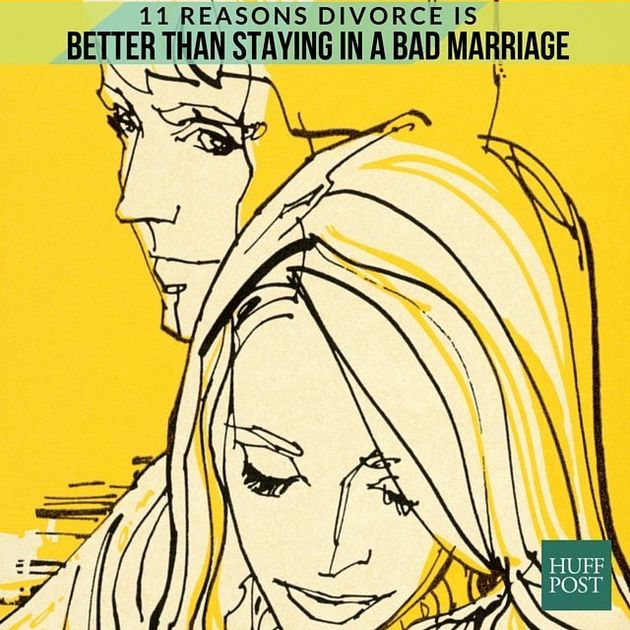
11 Reasons Divorce Is Better Than Staying In A Bad Marriage

When you’re considering divorce ― or reeling from your ex’s decision to end the marriage ― it’s easy to focus on the negatives: How will I possibly get by living on my own again? How will the kids be impacted by this? Am I doomed to be alone for the rest of my life?
While those concerns are understandable, it’s equally important to focus on the good that can come of being single. Below, HuffPost Divorce bloggers share 11 reasons divorce is preferable to staying in an unhappy, unhealthy marriage. 

1. Marriage may give you a sense of security but divorce gives you a new lease on life. 

“Staying in a bad marriage can provide security because at least you know how your life will go. But getting a divorce gives you hope ― the hope to be who you want to be, the hope to be happy and the hope to find someone else to love.” ―Barry Gold

2. Being a single parent is better than modeling an unhealthy relationship. 

“If you’re a parent with young kids, getting a divorce is better than staying in a badmarriage because these are formative years for them. They will likely seek out and emulate the types of relationships they see modeled. I want my relationships to be happy, healthy and mutually respectful, so that my children never settle for anything else in their own lives.” ― Lindsey Light 

3. Divorce clears the way for you to meet the right partner.

“Divorce is painful but it’s kind of like pulling off a Band-Aid: The anticipation is horrible but once it’s over, it’s pure relief. Bonus: It allows you the freedom to meet the person you were meant to be with!” ― Al Corona 

4. You get to focus on you for once.

“After divorce, you find yourself again and fall in love with the wonderful attributes that make you you. As a mother especially, you can parent with just your own mama instincts and all your love and energy can flow into your little one(s). You find genuine peace and happiness and an appreciation for life that may have been sucked out of you during your bad marriage.” ― Shelley Cameron 

5. Divorce isn’t the worst thing that can happen to your kids. Enduring a hostile home life is.

“After my first wife and mother of my five children left us permanently, I felt like going through divorce was the worst thing that could happen to a family. So when my second marriage was falling apart, as my kids sole and single parent, I was desperate to protect them from the trauma of another divorce. As a result, I kept the family in a situation that wasn’t good for any of us. The reality is, the worst thing for your children is for them to live in a hostile home and have them see you unhappy. My life and my children’s’ lives have gotten better and happier with each passing day after the divorce.” ― Matt Sweetwood  

6. There’s a big difference between loneliness and solitude. 

“My divorce helped me discover the gift of solitude when I once experienced the pain of loneliness. Now that I’ve learned to enjoy being alone, I’m free from that awful feeling of separation that comes from being with the wrong person.” ―Tammy Letherer

7. You and your partner may be stifling each other’s growth.

“I feel that divorce should rarely be the first choice because generally the only thing keeping a ‘bad’ marriage from being a ‘good’ marriage is sustained mutual effort. That being said, there are times that divorce is the best choice in order to allow both partners to grow and achieve the life they desire, and in some scenarios, the life they deserve.” ― Derick Turner 

8. A happier parent is a better parent. 

“Learning to let go and step into the unknown may be the single most important thing you can do for your own sanity and the sanity of those around you. Divorce proves that you have the courage to live a life of happiness. And if you’re happier, you’ll be a far more effective parent.” ― Carey Fan 

9. You can devote your energy to other important areas of your life. 

“If you have done all the work of trying to make the marriage better and nothing is changing, finding the courage to leave and move forward pays off in the long run. The pay off? You stop putting all your energy into a relationship that no longer works and put more energy into yourself and your kids.” ― Cherie Morris

10. You deserve a partner who’s just as invested in the relationship as you are. 

“Divorce is preferable to a marriage without love. We all deserve to be loved. I never want to be in a marriage where that partnership isn’t sacred and a priority.” ―Carly Israel

11. You lose a spouse but you gain happiness.  

“Divorce brought me happiness. Life is far too short to spend it immersed in an unhealthy relationship.” ― Nicole Lavery

Tuesday, June 14, 2016

5 Things My Ex-Husband Could Have Done To Save Our Marriage

By Audrey Cade for DivorcedMoms.com

 Five years have passed since my divorce. I was depressed and devastated by the demise of my relationship, and disappointed that my marriage had come to an end — but I can honestly say that I don’t regret now that this was the outcome. I acknowledge that I had a part in the demise of our union. I recognize that little-by-little I turned away from him and our actions toward one another slowly dissolved the connection we once had. Upon reflection, I can identify five critical things that he could have done differently throughout our marriage that could have saved it.

 1. Make me feel special.

 The once girlfriend, me, used to feel treasured and important to the once boyfriend him. This is an all-to-common predicament of romantic relationships. The initial glow of dating brings out the best in all of us, and we see the best in each other. Over time, the feelings of excitement and admiration tend to fade behind the drudgery of everyday responsibilities and familiarity. I was not naïve to think that our relationship would carry on indefinitely buoyed by clouds of first love energy. I knew a marriage would take work to remain strong, yet I hoped that I could continue to feel special as a wife. Sadly, he stopped making the effort to continue doing the little things to show he cared about me or thought of me as more than a co-habitant of his home, the maid, or mother of his children. I have since remarried, and I appreciate how much of a commitment it is to keep feeding the flame every day and to let your partner know, every day, how much they are loved and appreciated. My husband and I were both previously married; therefore, we are much more aware of how fragile and precious our marriage is and how necessary it is to never take one another for granted.

 2. Help out. 

According to traditional gender roles, the man works outside the home and completes more “manly” jobs, such as mowing the lawn, while the wife cares for the children and the home. My relationship mirrored those ideals, with the exception that I also worked full time. My days became filled with running in circles working, taking care of children, and eventually being responsible for all of the household chores. By the conclusion of our marriage, I was the one who did all of the shopping, cleaning, cooking, laundry, and the majority of child-rearing tasks. Somehow I managed it all. As years of bearing most of the weight of our household began to take their toll on me, I became resentful and angry. I finally convinced him to agree to take on one household chore to help me out: washing the dishes. He did as promised a few times, then we ended in a power struggle because he refused to continue doing them. I didn’t want to feel like I was his mother telling him what to do; yet, the only way I could get him to pull his weight was to nag. One spouse cannot be left to feel responsible for everything with little or no help.

 3. Make the marriage a priority.

 A marriage is like a flower that requires love and care to flourish. By the time we work eight hours or more in a day, sleep another eight hours at night, complete daily chores, and run around with the kids, there’s not much husband-wife time left. I was usually exhausted by the time I put the kids in bed and, disgusted because I felt like I had moved all of the day’s mountains myself. I often tried to get his attention during the evening to talk or spend time together. He developed a routine of coming home from work, plopping down in his recliner, eating his dinner in front of the TV, and not diverting his time or attention to myself or the kids for anything. He probably gave up on me because I was so wrapped up with the kids, and perhaps he didn’t feel that I had any time for him. To be fair, our marriage did need to come first — even before the kids. I had my priorities backwards for a long time because I thought that once I became a mother, they should come first. It was hard for me to recognize that for us to remain healthy, we needed to leave the kids with a sitter and go out on a date and find other ways to keep watering our flower and helping it grow. Two wrongs don’t make a right. I did what I did in my attempt to be the perfect mom, and he probably tuned me out because he felt like it was pointless to try.

 4. Grow with me. 

The superstition that breaking a mirror causes seven years of bad luck originates from a belief that one’s physical being is recreated every seven years; so, if you break a mirror, the soul could become entrapped in the shards of glass and take seven years to become whole again. I relate this to the growth and development that takes place within each person throughout life, seven years at a time. Your reflection in a mirror looks more mature in seven-year increments, and your perspectives, knowledge, and experiences grow by those leaps, as well. We are not the same people we once were. This is a natural transformation that occurs, made more complicated by sharing life with another who is also continually growing and changing. A couple has to work to grow together by staying connected through shared activities and interests, learning, experiencing life, and staying on the same path together. The more wise and mature version of yourself may not have much in common with the former you; but a couple needs to keep growing in sync by taking an interest in each other’s passions and progress to be sure to still have enough in common with one another to keep the relationship strong. Compatibility doesn’t mean that you still have everything in common, but you should still be intrigued and in sync. My ex and I grew from one seed into two sprawling vines, no longer recognizable to the other. I found myself speechless by things he would say, thinking to myself, “I don’t agree with that!” or embarrassed to be associated with the person he had become.

 5. Break up with the porn habit.

 I understand that men like to look, and temptations for lust are everywhere. I wanted to please my husband and be available to him. We became out-of-sync when I often went to bed at about 9pm to be ready to get up early the next morning while he often stayed up past midnight. I discovered that after I went to sleep, he would stay up to watch porn. I was most hurt by the fact that he chose to do this behind my back, rather than making me a part of his needs and desires. It made me feel undesirable, not “good enough,” and betrayed for keeping this side of himself from me. This progressed to create deeper problems with our intimacy and a bigger wedge between us.

Friday, June 10, 2016

Movie Friday-Legally Blonde

When a blonde sorority queen is dumped by her boyfriend, she decides to follow him to law school to get him back and, once there, learns she has more legal savvy than she ever imagined.

Wednesday, June 1, 2016

A Sincere Thank You

I would like to thank a few people who are responsible for a tremendous victory for The Law Offices of Cathy A. Marino.  First, to the Suffolk Superior Jury who heard the case.  Seven men and women, who did their civic duty, before and after a holiday weekend.  They took three days out of their busy lives to listen attentively, takes notes, and weigh the evidence in a fair, thoughtful and considered way. To Judge Douglas Wilkens, for conducting a smooth, even handed trial.
Thank you to Robert Strasnick of Principe and Strasnick of Saugus, MA, who presented the case brilliantly.  It's never easy having an attorney for a client, and Rob rose to the occasion, and never wavered in his faith that we would obtain a just result.  Finally, to my staff, who supported me, and insured that every 'T' was crossed, and every 'I' was dotted.  I am blessed to have them all for employees.

Monday, May 23, 2016

9 Conversations Married Men Dread Having, According To Therapists

From Huffington Post--

What conversations do guys really wish they could avoid having with their spouses?
Below, marriage therapists share nine things men complain about when they’re in their offices. 

1. “I know it’s late, but we need to talk...”

The next time something needs to be addressed, save the conversation for the morning, said Elisabeth J. LaMotte, a psychotherapist and founder of the DC Counseling and Psychotherapy Center. “We need to talk” conversations tend to be of a higher quality if you wait until you’re both well rested and ready to talk.
“The tension between women wanting to talk and men wanting to sleep is the stuff of old T.V. sitcoms,” she said. “Still, these days, there really is an epidemic of sleep-deprived couples lacking adequate communication.”

2. “Those shorts make you look like a teenager. Maybe you should wear something else?”

You dislike it when your spouse makes snide remarks about your new haircut or favorite baggy shirt. He probably feels the same way when you side-eye his new cargo pants, said Susan Heitler, a psychologist based in Denver, Colorado. 
“Who are you to set the standard of dress for him?” she said. “And ‘you should’ is a sure way to invite him to feel that you’re being too controlling.”

3. “I would have preferred if you just got me a card!” 

It’s the thought that counts with gifts, right? Still, chances are, your S.O. reallythought buying that pricey handbag the Macy’s salesperson pushed on him was thoughtful and generous. Acknowledge it with a simple “thank you,” even if you’re thinking, “That price tag! You shouldn’t have,” said M. Gary Neuman, a psychotherapist based in Miami Beach, Florida.
“Men like to feel like winners in their spouses’ eyes and get disheartened when they make attempts that are not met with enthusiasm,” Neuman said. “A spouse is better off being gracious and appreciative and then later outlining gestures that would be more meaningful.” 

4. “My ex would never do that.” 

Comparisons to exes only breeds contempt, said Kurt Smith, a therapist who specializes in counseling men. 
“It’s not uncommon for husbands to be living in the shadow of their partners’ exes,” he said. “But there are probably good reasons why you’re no longer with those other guys. Comparing your partner to your exes or to a best friend’s partner or even to ‘The Bachelor’ is unfair and makes men feel unloved.” 

5. “Ugh, I hate how you leave the dishes in the sink.”

You may want your spouse to be a little more diligent about the dishes or wish he’d slow down when driving, but there’s a right and wrong way to issue your complaint, reminded Tammy Nelson, a sex and relationship therapist and the author of The New Monogamy. Who wants to hear non-constructive criticism, whether you’re a man or woman? 
“Instead, use phrases that show appreciation for what he could do right,” she said. “Say ‘I appreciate it when you do it this way instead’ or ‘I love when you rub my back softly. Always remember, you get more of what you appreciate.”

6. “All you want is sex.” 

Yes, sex is a huge motivator in our lives but you’re insulting your spouse by assuming he’s only lending a hand in the hopes of it leading to sex, said Neuman. 
“Men do enjoy and desire sex but they hate when they’re trying to do something nice for their spouse and are suspected of ulterior motives,” he said. “It may even be true at the moment, but it doesn’t mean that it’s the only reason they do stuff.” 

7. “You never take out the trash. You always just let it pile up.”  

The trash is a placeholder for just about anything here. The important thing to note is that using all-encompassing, accusatory blanket terms like “never” and “always” is a very bad idea, said Nelson. 
“No one ever does anything ‘always’ or ‘never’ so take those two words out of your vocabulary,” she said. “Keep the conversation focused on what is happening now and avoid words that lump behavior into such huge categories.”

8. “Yes, but...” 

Agreeing with something, then adding “yes, but...” dismisses everything said before it, Heitler said. 
But deletes whatever came before,” she said. “No man (or woman) likes to have what he or she said dismissed like that.” 

9. “Remember when you made that one mistake, seven years ago?”

Maybe your partner forgot your anniversary a few years back. Maybe he made plans with his buddies on a weekend when you were headed to your parents. Whatever the case may be — whatever the mistake was — if you’ve forgiven him for doing it in the past, do your relationship a favor and let it go, said Smith. 
“A lot of guys feel like they can never escape their past because their wife never forgets about any mistake they’ve ever made,” he said. “And they hear about every one of those mistakes every single time they screw up.” 
The reality is, said Smith, “when a man feels like he never gets validated or appreciated for what he does right it usually leads him to tune his wife out.”  

Saturday, May 21, 2016

Movie Saturday--Lincoln Lawyer

Mick Haller is a defense lawyer who works out of his Lincoln. When a wealthy Realtor is accused of assaulting a prostitute, Haller is asked to defend him. The man claims that the woman is trying to get some money out of him. But when Haller looks at the evidence against him, he learns that this case might be linked to an old case of his.


Tuesday, May 17, 2016

6 Fights That Are A Total Waste Of Time In A Relationship


Below, marriage experts share six marital fights that aren’t worth your time. 


1. “We’re not having enough sex” — or anything else related to sex.

Your misgivings about sex with your partner — how often you’re having it, for instance, or your desire to try something new in the bedroom — are completelyvalid. But you’re not likely to change anything if you voice your complaints in a hostile way, said Amy Begel, a marriage and family therapist based in New York City. 
“Arguing about sex never works,” she told HuffPost. “Sex is the most intimate of connections between two people but you need to realize it’s primarily a non-verbal art form.”
Fighting about sex, said Begel, brings the “wrong kind of energy” and “kills the spark” you share as a couple. 
As she sees it, “imagination, seduction, affection, great conversation and well-placed flirting are more likely to positively transform a couple’s sex life.” 

2. “Why don’t you have time to call or text me while you’re at work?” 

It’s thoughtful and sweet that you want to talk to your S.O. throughout the day. But if she’s between meetings and super busy, recognize that she doesn’t need to hear every last detail of your “how I got the cat back inside the apartment” story. 
“It might be that she can’t multitask her attention at work and it’s better to wait until she’s away from the office grind to talk,” said Carin Goldstein, a marriage and family therapist based in Sherman Oaks, California. “So if you really need to chit-chat during the day, call a friend who has some free time and save yourself a no-win argument with your spouse.” 

3. “Ladies’ night again?”

It’s 10 p.m. and you know exactly where your wife is: At dinner with her friends, gossiping over a few glasses of Cabernet. You may be annoyed that she’s not spending that time with you but you need to let this one go, Goldstein said.
“Unless she is flying to Vegas for an overnight and coming home smelling like cheap men’s cologne, just let her have some downtime with her friends,” she said. “This is not a situation worth fighting over.”

4. “I put way more effort into this relationship than you.”

Stay clear of arguments about who’s the better parent, spouse or breadwinner. There’s no room from oneupmanship in a healthy marriage, said Begel. 
“Fights like this mask underlying tensions that need to be addressed openly, without kicking the other person in the process,” she said. “These are important challenges that need to be worked through — your feelings of neglect or lack of appreciation matter — but don’t make it a competition.” 

5. “I’m right about this. You’re wrong.”

It’s hard to love someone who always needs to be right. The next time you’re being a little self-righteous, press pause on the argument and tell your spouse you need to agree to disagree, said Sheri Meyers, a marriage and family therapist in Los Angeles. 
“The truth is neither one of you is 100 percent right and neither one of you is 100 percent wrong,” she said. “The task at hand is to stop competition (me vs. you) and start cooperation (you are, after all, a team). Instead of looking for what’s wrong, search for what you can agree on.” 

6. “Why are you working so much?”    

In an ideal world, we’d all have a healthy, vacation-filled work-life balance. But in all likelihood, your spouse has no control over demands at work. If he’s already exhausted and feeling put-upon at the office, starting a fight about his work hours is the wrong tack to take, said Meyers. 
“Rather than fighting about your S.O. spending too much time at work, make the time you do have together even more precious and special by filling it with the three A’s: attention, appreciation and affection,” she said. “When you put your focus on the good things that you value in your relationship, the time you do spend together will be more fun, loving and fulfilling.”

Tuesday, May 10, 2016

This Behavior Is The #1 Predictor Of Divorce, And You’re Guilty Of It


Ever catch yourself rolling your eyes at your partner or getting a little too sarcastic during a conversation? Those seemingly small behaviors are not that innocent after all. 
According to renowned researcher John Gottman, contemptuous behavior like eye-rolling, sarcasm and name-calling is the number one predictor of divorce.
For 40 years, the University of Washington psychology professor and his team at the Gottman Institute have studied couples’ interactions to determine the key predictors of divorce — or as Gottman calls them, “the four horsemen of the apocalypse.” 
Contempt is the number one sign, followed by criticism, defensiveness and stonewalling (emotionally withdrawing from your partner.)
So how do you curb contempt in your own marriage and stave off divorce? Below, experts share seven things you can do to keep contempt in check.

1. Realize that delivery is everything. 

“Remember, it’s not what you say, but how you say it that makes all the difference. Contempt often comes in the form of name-calling, snickering, sarcasm, eye-rolling and long heavy sighs. Like a poison, it can erode the trust and safety in your relationship and bring your marriage to a slow death. Your goal is to be heard. You need to present your message in a way that makes this happen without doing damage to the relationship.” — Christine Wilke, a marriage therapist based in Easton, Pennsylvania

2. Ban the word “whatever” from your vocabulary. 

“When you say ‘whatever’ to your partner, you’re basically saying you’re not going to listen to them. This sends them a message that whatever they’re talking about is unimportant and has no merit to you. This is the last thing you want your spouse to hear. Sending messages (even indirectly through contempt) that they’re not important will end a relationship pretty quickly.” — Aaron Anderson, a Denver, Colorado-based marriage and family therapist

3. Stay clear of sarcasm and mean-spirited jokes. 

“Avoid sarcasm and comments like, ‘I’ll bet you do!’ or ‘Oh, that was super funny” in a rude tone of voice. While you’re at it, don’t make jokes at the expense of your partner or make universal comments about his or her gender (‘You would say that — you’re a guy’).” — LeMel Firestone-Palerm, a marriage and family therapist 

4. Don’t live in the past. 

“Most couples start showing contempt because they have let a lot of little things build up. To avoid contempt all together, you need to stay current in your communications along the way. If you’re unhappy about something, say it directly. Also, acknowledge the valid complaints your partner has about you — you’ll probably be less self-righteous the next time you fight.” -Judith and Bob Wright,authors of The Heart of the Fight: A Couple’s Guide to Fifteen Common Fights, What They Really Mean, and How They Can Bring You Closer

5. Watch your body language. 

“If you find yourself rolling your eyes or smirking, it is a signal that your relationship could be headed for trouble. Try taking a break from each other if things get heated, or try focusing on positive aspects that you like about your partner.” — Chelli Pumphrey, a counselor based in Denver, Colorado

6. Don’t ever tell your spouse, “you’re overreacting.” 

“When you say your S.O. is overreacting, what you’re really saying is that their feelings are unimportant to you. Instead of telling your partner that they’re overreacting, listen to their point of view. Try to understand where they’re coming from and why they feel that way. They have those feelings for a reason.” — Aaron Anderson 

7. If you find yourself being contemptuous, stop and take a deep breath.

“Make it your goal to become aware of what contempt is. Then find out specifically what it looks like in your marriage. When you feel the urge to go there, take a deep breath, and say ‘stop’ quietly to yourself. Find another way to make your point. Contempt is a bad habit like smoking or nail biting. With work, you can break it.”